If you have spent any time in fintech or treasury circles, you have probably heard the phrase “API-first banking” used as the answer to everything. Faster integrations. Real-time data. Seamless connectivity. It sounds simple and almost too good to be true.
And that is where the issue starts.
APIs are powerful tools. They help systems connect and exchange data more easily. But they are not a complete solution. In reality, things are more complex than they seem.
Just because systems connect through an API does not mean they work perfectly together. Data formats can differ, processes may not align, and each bank builds its APIs in its own way.
Relying only on APIs is like thinking that building a highway will solve all traffic problems. It helps, but you still need rules, structure, and coordination.
The same applies to banking. Connectivity is not just about connecting systems. It is about making sure everything works together smoothly and reliably.
So while API-first banking sounds appealing, it often hides the real complexity. And that is why it does not always deliver what it promises.
What does API-first banking actually mean
At its core, API-first banking means that banks make their services available through application programming interfaces, or APIs. These APIs act like bridges between systems. They allow companies to connect directly to a bank, pull data, and even trigger actions such as payments.
In simple terms, instead of logging into a bank portal and downloading files, systems can “talk” to each other automatically. Data can move in real time, and processes can run in the background without manual effort.
This sounds like a big step forward, and in many ways, it is.

The rise of APIs in financial services
APIs became popular because they promised speed and flexibility. Before APIs, many companies relied on file transfers or manual uploads. These methods were often slow, error-prone, and hard to scale.
With APIs, things looked much easier. Systems could connect faster. Data could be updated instantly. Treasury teams could access balances, transactions, and payment statuses without waiting.
Payments, balances, transactions. Everything available through a simple connection.
It is easy to see why this approach gained so much attention.
Why APIs became the default narrative
APIs quickly became the face of modern banking. They sounded clean, efficient, and future-ready. For developers and businesses alike, they offered a more flexible way to build and scale solutions.
In a world focused on digital transformation, APIs fit perfectly into the story. They became a symbol of progress and innovation.
But there is a catch.
The idea of API-first banking often focuses only on the benefits, not the challenges. It creates the impression that APIs alone can solve complex connectivity problems.
In reality, things are rarely that simple.
The illusion of simplicity
APIs are often presented as simple, plug-and-play solutions. The message is clear. Connect once, and everything works smoothly. No friction, no hassle.
But in practice, it is rarely that easy.
At first glance, APIs look clean and straightforward. You see endpoints, clear functions, and structured data. It gives the impression that integration is quick and predictable. Yet once you start working with multiple banks, the picture changes.
APIs are not plug-and-play
Each bank builds its APIs in its own way. They use different structures, different authentication methods, and different levels of documentation. Some are well designed and easy to use. Others are more complex and less consistent.
Connecting to one bank might feel manageable. But when you need to connect to several banks, the effort grows fast. You are no longer dealing with one system, but with many systems that all behave differently.
You end up managing multiple connections, each with its own rules, quirks, and limitations. This increases both the technical effort and the risk of errors.
Hidden complexity behind endpoints
What looks simple on the surface often hides deeper complexity. Behind each API endpoint, there are many details to consider.
Data formats are not always the same. One bank may return data in one structure, while another uses a slightly different format. Error messages can vary, making troubleshooting harder. Some APIs have limits on how often you can call them, which can affect performance.
Even documentation can be a challenge. It is not always complete or easy to follow, which slows down development.
It is like ordering food from ten different restaurants, each using a different language and menu style. You can still order, but it takes more time and effort to understand each one.
Connectivity is more than APIs
This is where the API-first story starts to fall apart. APIs are important, but they are only one part of a much bigger connectivity landscape.
If you look at how banks actually operate today, you will see a mix of technologies, old and new. APIs are just one option among many.
File-based connections still matter
Despite all the attention APIs get, file-based connections are still widely used. Many banks continue to rely on formats like MT940, ISO 20022 XML, and even custom proprietary files.
These formats are deeply built into banking systems. They support critical processes such as reporting and payments. For many banks, they are stable, trusted, and not going away anytime soon.
So ignoring file-based connectivity is simply not realistic.
Bank-specific formats and protocols
Even when banks offer APIs, they often still support older methods at the same time. This creates a mixed environment where companies must handle both modern and legacy connections.
Each bank may use its own formats, protocols, and communication methods. One bank might use SFTP with specific file structures, while another offers APIs with different data models.
As a result, companies need to manage multiple ways of connecting, often at the same time.
Why standardization is still limited
In theory, standards should solve this problem. And while standards like ISO 20022 help, they are not applied in the same way everywhere.
Banks can interpret standards differently. Some add their own fields or variations. On top of that, regional differences make things even more complex.
The result is not a single, unified system, but a patchwork of connections that need to be managed carefully.
The fragmentation problem
Imagine trying to build a puzzle where every piece comes from a different box. Some pieces almost fit, others do not fit at all. That is what banking connectivity often feels like in practice.
Instead of one clear system, you are dealing with many different setups that need to work together.
Every bank is different
There is no single standard that all banks follow when it comes to APIs or connectivity. Each bank builds its own systems based on its history, technology, and business priorities.
This means that even if two banks offer similar services, the way you connect to them can be very different. One API might be simple and well documented, while another might be more complex and harder to use.
For companies, this creates extra work. Every new bank connection becomes a new project.
Regional inconsistencies
On top of that, differences between regions make things even more complicated. What works well in one part of the world may not work the same way elsewhere.
In some regions, banks have invested heavily in APIs and digital services. In others, traditional methods like file transfers and host-to-host connections are still widely used and trusted.
Infrastructure also plays a big role. Some markets have modern banking systems and strong digital adoption, while others are still developing and rely on older technology.
These differences mean that companies cannot apply the same setup everywhere. A solution that works in one country may need to be adjusted or rebuilt in another.
This fragmentation makes it hard to scale connectivity. Instead of building once and reusing the same model, companies often need to adapt again and again.
And that takes time, effort, and resources.
The integration burden on corporates
Now let’s look at who actually deals with all this complexity. It is not the banks. In most cases, the responsibility falls on the companies that need to connect to those banks.
For corporates, especially treasury teams, connectivity is not just a technical task. It becomes an ongoing effort that requires time, planning, and constant attention.
Internal it constraints
Corporate IT teams are often already busy with many projects. Adding multiple bank integrations on top of that can quickly stretch resources.
Each API connection takes time to build. It requires technical knowledge, coordination with the bank, and careful testing. And even after the connection is live, issues can still appear and need to be resolved.
Not every company has the capacity or expertise to manage this at scale.
Maintenance and versioning challenges
Another challenge is that APIs do not stay the same. Banks update them, release new versions, or sometimes remove old endpoints.
This means that integration is not a one-time task. It needs regular updates and monitoring to keep everything running smoothly.
Over time, managing multiple connections can feel like maintaining a fleet of vehicles. Each one needs care, updates, and occasional fixes.
If not managed properly, this can lead to delays, errors, and increased operational risk.
Security and compliance realities
Connectivity is not just about moving data from one system to another. It is about doing this in a secure and compliant way. This is where things often become more complex than expected.
Authentication complexity
APIs use different methods to make sure access is secure. These include OAuth, tokens, and digital certificates. While these tools are important, they are not always easy to manage.
Each bank may use its own approach. One bank might require token refreshes every few hours, while another uses certificates with strict renewal rules. Managing all these methods across multiple connections takes careful planning.
If something goes wrong, access can fail, and processes can stop. That is why security is not just a setup step. It needs ongoing attention.
Regulatory differences
On top of security, there is compliance. Regulations are not the same everywhere, and this creates additional challenges for companies.
Each country or region has its own rules for how financial data can be accessed, stored, and shared. Some markets encourage digital connectivity, while others have stricter controls or different reporting requirements.
For companies operating across borders, this means dealing with multiple regulatory frameworks at the same time. Each one may require different processes, approvals, or technical setups.
This adds another layer of complexity. If not managed properly, it can lead to delays, compliance risks, or even penalties.
So connectivity is not just a technical challenge. It is also a regulatory one that requires careful attention.
The missing layer: orchestration
This is where many API-first discussions fall short. They focus on access, but not on control. What is often missing is orchestration.
What orchestration means in banking connectivity
Orchestration is the layer that brings everything together. It manages different connections, standardizes data, and ensures that processes run smoothly.
You can think of it as a conductor leading an orchestra. Each instrument plays its part, but without coordination, the result would be chaos.
In the same way, orchestration ensures that all connections work in harmony.
Why orchestration is critical
Without orchestration, companies have to manage each connection separately. This leads to duplicated work, inconsistent data, and a higher chance of errors.
APIs give you access to data. Orchestration makes that data usable and reliable.
It turns a collection of connections into a structured system.
Real-time vs reliable connectivity
Real-time data is often seen as the goal. Instant updates, live balances, immediate insights. It sounds ideal.
But there is a trade-off.
The trade-off between speed and stability
Real-time APIs can be sensitive to issues like network delays, downtime, or rate limits. If one connection fails, data flow can be interrupted.
In contrast, batch-based systems may be slower, but they are often more stable and predictable.
In many cases, reliability is more important than speed. After all, having slightly delayed data that you can trust is often better than real-time data that is incomplete or inconsistent.
It is like choosing between a fast sports car and a strong truck. Speed is useful, but reliability gets the job done every time.
The role of aggregation platforms
So how do companies deal with all this complexity in a practical way? Building and maintaining many bank connections internally is not always realistic.
This is where aggregation platforms come in.
Centralizing connectivity
Aggregation platforms provide a single point of access to multiple banks. Instead of connecting to each bank one by one, companies connect to the platform.
From there, the platform manages the rest.
This approach simplifies the setup. You build one connection instead of many. It also makes it easier to add new banks later, without starting from scratch each time.
Reducing operational burden
Aggregation platforms do more than just connect systems. They handle many of the challenges behind the scenes.
They take care of format conversions, so data looks consistent no matter where it comes from. They manage different protocols and communication methods. They also handle updates, maintenance, and changes in bank APIs.
As a result, internal teams do not need to worry about every technical detail. They can spend less time fixing connections and more time focusing on improving processes and making better financial decisions.
In simple terms, aggregation platforms remove much of the heavy lifting and make connectivity easier to manage.
Why API-first alone fails treasury teams
Treasury teams need more than just a way to connect to banks. They need clear, reliable, and consistent information to make decisions. Connectivity is only useful if it leads to better visibility and control.
This is where API-first alone often falls short.
Lack of visibility
When companies rely only on individual API connections, data often comes in separate streams. Each bank sends data in its own format and at its own time.
This creates a fragmented view. One account may update in real time, while another is delayed. Some data may be detailed, while other data is limited.
As a result, it becomes difficult to see the full cash position across all banks. Treasury teams are left trying to piece together the bigger picture, which takes time and effort.
Inconsistent data flows
Inconsistent data is a major challenge. When formats differ and timing is not aligned, errors can occur more easily. Data may need to be cleaned, adjusted, or manually checked.
This leads to delays and extra work. Instead of saving time, teams end up creating workarounds to fix issues.
And that goes against the main goal of automation. Instead of simplifying processes, it adds another layer of complexity.
For treasury teams, consistency is key. Without it, even the best connections lose their value.
A more realistic approach to connectivity
So if API-first alone is not enough, what actually works in practice?
The answer is a more balanced and flexible approach. One that accepts the reality of today’s banking landscape instead of trying to simplify it too much.
Multi-channel connectivity
Instead of relying only on APIs, companies should use a mix of connection methods. This can include APIs, file-based connections, SWIFT, and other channels.
Each method has its strengths. APIs are great for real-time data. Files can be more stable for reporting. SWIFT is still widely used for global payments.
The key is to use the right tool for the right task, rather than forcing everything into one model.
Abstraction layers
Managing multiple connection types can quickly become complex. This is where abstraction comes in.
An abstraction layer sits on top of all connections and hides the technical differences. It provides a single, standardized interface, no matter how the data is delivered underneath.
You can think of it like a translator. Different banks speak different “languages,” but the abstraction layer turns everything into one common format.
This makes systems easier to manage and scale.
How modern treasury platforms solve this
Modern treasury platforms are designed with this complexity in mind. They do not rely on one method alone. Instead, they combine multiple approaches into one solution.
Unified connectivity models
These platforms offer a single point of access to many banks and channels. Whether it is APIs, files, or SWIFT, everything is managed through one interface.
This reduces the need for multiple integrations and simplifies daily operations.
Automation and normalization
Another key benefit is automation. Data from different sources is automatically standardized, so it looks consistent across all banks.
Processes such as reconciliation, reporting, and payment handling can also be automated.
This reduces manual work, lowers the risk of errors, and gives treasury teams more reliable data to work with.
Future of banking connectivity
APIs are not going away. In fact, they will continue to play an important role in how companies connect to banks and access data.
But the way we think about APIs is changing.
APIs as part of a broader ecosystem
The future is not about choosing APIs over everything else. It is about using APIs as one part of a larger, more complete setup.
This means combining APIs with orchestration, aggregation, and standardization. Together, these elements create a stronger and more reliable connectivity model.
APIs provide speed and access. Orchestration brings control. Aggregation simplifies connections. Standardization ensures consistency.
When these pieces work together, companies get the full value of digital banking.
In the end, the goal is not just to connect systems. It is to create a setup that is scalable, reliable, and easy to manage.

Conclusion
API-first banking is not wrong. It is simply not the full picture.
APIs are a strong and useful tool. They help companies move faster and connect systems more easily. But on their own, they cannot solve all the challenges of banking connectivity. Without orchestration, standardization, and support for different connection methods, APIs fall short.
For companies, the focus should not be on following trends or using the latest buzzwords. The real goal is to build a setup that works in practice. One that is stable, scalable, and easy to manage over time.
This means looking at the bigger picture. Combining different technologies. Making sure data is consistent. And creating processes that teams can rely on every day.
In the end, connectivity is not just about how you connect to banks. It is about how well everything fits together and supports better decisions.
Want to find out what Cobase can do for you?
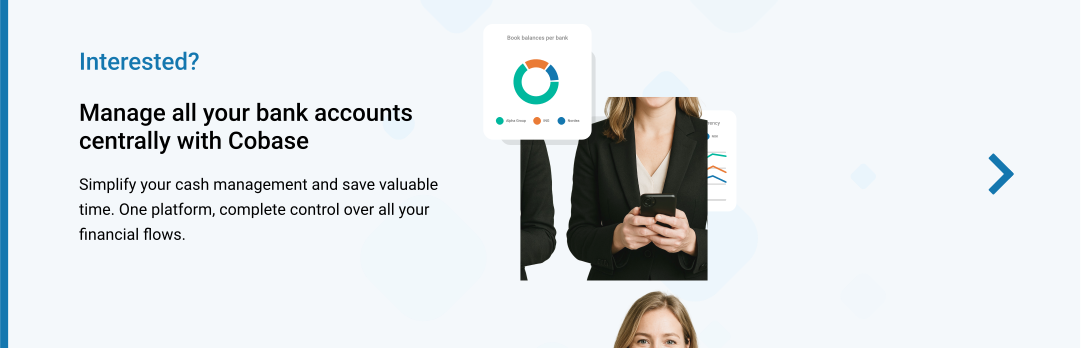
Cobase helps you move beyond the limits of API-only connectivity by offering a single platform that connects all your banks in one place, using APIs, files, SWIFT, Host-to-Host (SFTP), EBICS, and more. It takes care of the complexity behind the scenes by standardizing data, managing different formats, and ensuring reliable connections across regions. This means you get a clear and consistent view of your cash, fewer manual tasks, and less pressure on your IT team. Instead of juggling multiple integrations, you can focus on making better financial decisions with accurate, real-time insights.
Frequent Asked Questions (FAQs)
1. Are APIs still important in banking connectivity?
Yes, APIs are essential for real-time access and automation, but they should be part of a broader connectivity strategy.
2. Why can’t companies rely only on APIs?
Because banks differ in implementation, and APIs alone do not address fragmentation, legacy systems, and operational complexity.
3. What is orchestration in banking connectivity?
Orchestration is the layer that manages and standardizes multiple connections, ensuring consistent data flow and control.
4. How do aggregation platforms help?
They centralize connectivity, reduce integration effort, and handle differences between banks and formats.
5. What is the best approach to bank connectivity?
A hybrid approach that combines APIs, file-based connections, and orchestration for flexibility and reliability.

