Managing multiple bank relationships used to be a sign of growth. More banks meant more markets and more opportunities. Today, it often feels like operational chaos. Different portals. Different formats. Different approval processes. Different cut-off times. Each bank has its own system, and together they create unnecessary complexity.
Over time, this slows teams down. Checking balances, approving payments, or downloading statements can take much longer than they should. Instead of focusing on managing liquidity, finance and treasury teams spend their time switching between platforms and updating spreadsheets.
If this sounds familiar, you are not alone. Many companies reach a point where separate banking systems become a burden rather than a benefit.
Connecting multiple banks to a single platform changes that situation completely. Payments, reporting, approvals, and balances are managed in one place. Processes become consistent. Visibility improves. Control becomes stronger.
Instead of reacting to daily operational issues, your team can focus on making better financial decisions.
So how does it work, and how can you implement it successfully? Let’s break it down.
Why companies are consolidating bank connections now
The pressure on treasury and finance teams has never been higher. Leadership expects clear and timely insight into cash positions. Risk teams demand stronger controls and full transparency. Markets move quickly, interest rates change, and fraud threats become more advanced every year.
In this environment, working with a fragmented banking setup creates serious challenges. When information is spread across multiple portals and systems, it is difficult to see the full picture. Teams spend valuable time collecting data instead of analyzing it. Decisions are sometimes made based on incomplete information simply because there is no single source of truth.
Running separate banking systems is like trying to drive a car while constantly switching between dashboards. You might still move forward, but your attention is divided and you cannot see everything clearly at the same time. That increases the risk of mistakes and slows down reaction times.
At the same time, companies are expanding internationally, adding new entities, and working with more banking partners. This growth increases complexity even further. Without a centralized approach, every new bank adds more operational work and more potential risk.
Centralization is no longer just about convenience. It is about control, speed, and agility. By consolidating bank connections into one platform, companies create a stable foundation for better visibility, stronger governance, and faster decision-making. In today’s financial landscape, that foundation is essential.
The hidden cost of bank portals
At first glance, bank portals seem manageable. One login here. Another there. It does not feel like a big problem. But as your organization grows, complexity multiplies quickly. What worked for two banks becomes difficult with five. With ten banks across different countries, it can turn into a daily struggle.
Each portal comes with its own rules and structure:
-
User management rules
-
Approval workflows
-
File formats
-
Security tokens
-
Reporting layouts
This means your team must constantly adapt. A payment that takes three clicks in one portal may take ten in another. A statement might be easy to download from one bank but require manual formatting from another. Even simple tasks like resetting a password or updating a user role can become time-consuming.
Now imagine maintaining all of this across ten banks in five countries. Different time zones. Different holiday calendars. Different regulatory requirements. Every small difference adds another layer of work.
Over time, the cost becomes clear. Time drains away on administrative tasks. Errors start to appear because processes are not consistent. Visibility becomes fragmented, with cash balances spread across separate systems. And worst of all, no single platform provides a complete and reliable overview of your total liquidity.
The real cost of bank portals is not just inconvenience. It is the loss of time, clarity, and control.

Why spreadsheets break at scale
Spreadsheets feel flexible. Until they don’t.
At the beginning, they seem like the perfect solution. You can build your own structure, add formulas, create tabs for each bank, and adjust everything whenever needed. For a small setup with one or two accounts, this approach can work reasonably well.
But as the number of accounts grows, so does the risk. Manual balance uploads and payment tracking might work for two accounts. At twenty accounts, across several entities and currencies, they become a serious weakness. What once felt organized now feels fragile.
One missed update can distort your liquidity view. One incorrect formula can mislead a funding decision. A small copy and paste mistake can lead to duplicated or missing data. These errors are rarely dramatic. They are subtle, which makes them even more dangerous.
Then there is version control. Who has the latest file? Who changed the forecast? Was that number updated before or after the last payment run? When multiple people work in the same spreadsheet, clarity quickly disappears. Instead of supporting transparency, the file becomes a source of confusion.
Spreadsheets are powerful tools, but they are not designed to manage complex, multi-bank environments. When your liquidity strategy depends on copy and paste, you are operating on thin ice. The larger the organization becomes, the thinner that ice feels.
What connecting multiple banks actually includes
Connecting banks to a single platform is more than just payment integration. It is not only about sending payments from one system instead of logging into multiple portals. It creates a structured environment for managing all your core banking activities in one place.
A strong multi-bank setup usually covers four key areas:
-
Audit trails and compliance controls
Payment initiation includes creating and submitting payments, validating details, and tracking their status. When centralized, the process becomes consistent across all banks.
Balance and statement reporting provide clear visibility of your cash position. Instead of manually downloading files, balances and transactions are automatically consolidated, giving you a reliable overview.
Approval workflows ensure that internal policies are applied correctly, with clear roles, limits, and segregation of duties. Audit trails record every action, making compliance and reviews much easier.
In short, connecting multiple banks is about more than convenience. It is about control, visibility, and stronger financial governance.
Payments and approvals in one workflow
A unified platform brings structure and consistency to one of the most sensitive areas of treasury operations: payments.
It allows you to:
-
Create single and bulk payments
-
Validate payment details before submission
-
Apply standardized approval rules
-
Submit payments to multiple banks
-
Track payment statuses in one place
Instead of logging into different portals and adjusting your process each time, your team works within one clear workflow. Payment files are created in a consistent format. Beneficiary details can be checked automatically. Errors can be identified before they reach the bank.
Approval processes also become more transparent. You can define clear maker-checker rules, set approval limits, and assign roles based on responsibility. Whether the payment goes to Bank A or Bank B, the internal process remains the same. This reduces confusion and lowers the risk of mistakes.
Status tracking is another major advantage. Rather than checking several portals to confirm whether a payment has been accepted or rejected, you can monitor everything from a single dashboard. This improves response times if an issue occurs.
Instead of adapting your internal process to each bank, you standardize internally and let the platform handle bank-specific differences in the background.
Think of it as using one universal remote instead of ten separate ones. The device behind the screen may be different, but the way you control it stays simple and familiar.
Statements, balances, and intraday reporting
Cash visibility is where centralization delivers immediate value. When you can clearly see your full liquidity position, decision-making becomes faster and more confident.
A strong multi-bank platform consolidates:
-
End-of-day statements
-
Intraday statements
-
Current and available balances
-
Transaction-level data
Instead of collecting this information manually from different bank portals, the data flows automatically into one system. This saves time and reduces the risk of missing or outdated information.
End-of-day statements give you a reliable closing position for reconciliation and reporting. Intraday statements and updated balances provide a more dynamic view of cash movements throughout the day. Transaction-level data helps you understand what is driving changes in your balances, whether it is supplier payments, incoming customer funds, or internal transfers.
When all of this information is visible in one dashboard, you no longer need to piece together the cash picture like a puzzle. You can quickly identify surplus cash, funding needs, or unusual transactions.
That shift alone can transform daily treasury routines. Instead of spending the morning gathering data, your team can start the day analyzing it and taking action.
What real-time means in practice
“Real-time” does not always mean second-by-second updates. In treasury, it usually means information is available quickly enough to support confident decisions.
Some banks offer API-based balance updates throughout the day. Others provide intraday reports at set intervals. In some cases, data is still delivered through scheduled daily files. The speed depends on the bank and the region.
What truly matters is clarity. Treasury teams need to know how current the data is before acting on it. A reliable platform clearly shows timestamps and update frequency, so there is no confusion about when balances were last refreshed.
Real-time is not just about speed. It is about having data that is timely, transparent, and trustworthy.
Integration options: the three main paths
There is no single universal connection method that works perfectly for every bank and every company. In practice, most organizations use a mix of three main connectivity approaches. The right choice depends on your banking landscape, transaction volumes, geographic presence, and internal requirements.
A smart connectivity strategy focuses on reliability, scalability, and control rather than trying to force one method to fit all situations.
Host-to-Host connections
Host-to-host connections create a direct and secure link between your platform and a specific bank. This setup allows data and payment files to move automatically between systems without manual intervention.
They are often used for:
-
High-volume payments
-
Critical operational accounts
-
Large enterprise banking relationships
Because the connection is direct, companies gain strong control over the process. It is typically stable and well-suited for complex or high-value payment flows.
However, each bank usually requires its own setup, configuration, and testing. This can increase implementation effort, especially if you work with many banking partners. Still, for key accounts, host-to-host often delivers high reliability and performance.
SWIFT connectivity
SWIFT provides standardized financial messaging between corporates and banks worldwide. It creates a common language for payment instructions and reporting messages.
It is especially useful for:
-
International treasury operations
-
Standardized reporting across multiple banks
-
Centralized payment frameworks
With SWIFT, companies can connect to many banks through one structured channel. This supports consistency and reduces the need for multiple separate integrations.
At the same time, SWIFT requires proper governance, certification, and operational setup. There are rules to follow and security requirements to meet. When managed correctly, it offers broad coverage and strong standardization.
APIs
APIs are increasingly used for balance and transaction reporting. They allow systems to exchange data directly and often provide faster updates compared to traditional file transfers.
They can offer:
-
Faster data refresh
-
Simplified integration
-
Modern authentication methods
APIs can improve visibility and reduce manual work, especially for reporting use cases. However, coverage varies depending on the bank and region. Not all banks provide the same level of API functionality, and capabilities may differ between institutions.
APIs are powerful tools, but they are not universally available. In many cases, they are combined with host-to-host or SWIFT connectivity to create a complete multi-bank setup.
How to connect multiple banks to one platform
Now let’s move from theory to action. Connecting multiple banks is not just a technical project. It is an operational change that affects processes, controls, and daily routines. A structured approach makes the difference between a smooth transition and unnecessary disruption.
Step 1: map your bank landscape
Start with a detailed inventory of your current banking setup. This should include:
-
All banks and branches
-
Accounts and currencies
-
Legal entities
-
Regions and countries
-
Internal stakeholders
Go beyond a simple list of accounts. Understand which accounts are critical, which are high volume, and which are used only occasionally. Identify who owns each relationship and who depends on each account.
This mapping prevents surprises later. It gives you a clear overview of complexity and helps you prioritize where to start.
Step 2: define your use cases first
Avoid vague goals like “connect everything.” That approach often leads to delays and confusion.
Instead, define your specific needs:
-
Payment types such as supplier, payroll, or tax payments
-
Reporting requirements for reconciliation and management reporting
-
Liquidity visibility needs for forecasting and funding decisions
-
Approval hierarchies across entities and regions
-
Compliance expectations and internal controls
Your use cases determine your technical approach. When you know exactly what you want to achieve, choosing the right connectivity and configuration becomes much easier.
Step 3: choose the right connectivity mix
Most organizations adopt a hybrid model rather than relying on a single method.
For example:
-
Host-to-host for primary payment banks
-
SWIFT for global reporting
-
APIs for balance visibility
Using multiple methods is not weakness. It is practical optimization. Each bank and each use case may require a slightly different solution. The goal is to build a flexible setup that balances efficiency, coverage, and reliability.
Step 4: standardize data and formats
Banks use different formats. Your internal process should not depend on those differences.
Common standards include:
-
Legacy MT messages
By standardizing internally, you create consistency for your team. The platform can translate formats where necessary, but your users work with one clear structure. This reduces errors and simplifies training.
Step 5: design approval structures carefully
Centralization increases control, but only if it is configured correctly.
Define:
-
Maker-checker rules
-
Approval limits
-
Segregation of duties
-
Emergency workflows
-
Role-based permissions
Clear approval structures protect against fraud and operational risk. They also make responsibilities transparent. Everyone knows who can create, approve, or release payments.
Security and compliance considerations
When connecting multiple banks, security must be foundational. You are centralizing access to accounts, payments, and sensitive financial data. This increases efficiency, but it also increases responsibility. A strong security framework ensures that centralization reduces risk instead of creating new vulnerabilities.
Security should not be treated as a final step after implementation. It needs to be built into the design from the beginning.
Authentication and access management
Access control is the first line of defense. You should implement:
-
Multi-factor authentication
-
Role-based access
-
Single sign-on where possible
-
Clear user lifecycle processes
Multi-factor authentication adds an extra layer of protection beyond passwords. Role-based access ensures that users only see and perform actions relevant to their responsibilities. Single sign-on can simplify user management while maintaining strong control.
It is also important to manage joiner, mover, and leaver processes carefully. When employees change roles or leave the company, their access rights must be updated immediately. Centralization should strengthen security, not weaken it.
Encryption and data protection
Financial data must be protected at all times. This includes:
-
Encryption in transit
-
Encryption at rest
-
Strong key management
-
Secure certificate handling
Encryption in transit protects data as it moves between your platform and the banks. Encryption at rest secures stored data within the system. Strong key management and proper certificate handling prevent unauthorized access and reduce technical risk.
Your platform becomes the gateway to your cash. Treat it with the same level of care as your most critical financial systems.
Common pitfalls to avoid
Even strong projects can fail when basic planning is skipped. Connecting multiple banks is not only a technical task. It affects processes, responsibilities, internal controls, and daily routines. If priorities are unclear or ownership is not defined, the initial improvement can quickly turn into new complexity.
Clear planning, realistic timelines, and strong internal coordination are just as important as the technology itself.
Trying to connect everything at once
Ambition is good. Overreach is dangerous.
Many organizations aim to connect all banks, all accounts, and all payment types at the same time. On paper, this sounds efficient. In reality, it often creates pressure on internal teams, increases dependency on banks’ response times, and raises the risk of configuration mistakes.
When too many elements move at once, it becomes difficult to identify the root cause of issues. If something fails, is it a format problem, an approval rule issue, or a bank-specific setting? Complexity multiplies quickly.
Instead, start with high-impact accounts and scale gradually. Focus first on the banks that handle the highest volumes or carry the highest operational risk. These accounts usually deliver the fastest return in terms of visibility and efficiency.
Deliver value early, learn from the first implementation phase, and apply those lessons to the next group of banks. A phased approach allows teams to build experience, adjust configurations, and strengthen governance along the way.
Connecting multiple banks is a journey, not a single event. Taking structured steps ensures that progress remains stable and sustainable.
Ignoring bank-specific requirements
Banks are not identical. Even when they offer similar services, the details often differ. These differences can include:
-
Cut-off times
-
Required fields
-
Local regulations
-
File validation rules
At first, these variations may seem small. However, in practice, they can have a major impact on daily operations. A payment submitted after a local cut-off time may be processed the next day. A missing mandatory field can lead to rejection. A reporting format may not align exactly with your internal reconciliation process.
If these differences are ignored during implementation, problems will likely appear during testing or shortly after go-live. Payments may be rejected unexpectedly. Reports may not match expectations. Users may need to intervene manually. Over time, this can reduce confidence in the system.
Planning for exceptions from day one is essential. Take the time to understand each bank’s specific requirements and document them clearly. Work closely with both the bank and your platform provider to ensure configurations reflect these details.
A well-designed platform should be able to handle differences in a controlled and structured way. When bank-specific rules are managed properly, your internal process can remain consistent while the technical variations are handled in the background.
Forgetting the operating model
Technology alone does not solve operational questions. A new platform can improve processes, but it does not automatically define responsibilities. Without a clear operating model, even the best system can become difficult to manage over time.
After go-live, important questions need clear answers. Who owns:
-
Connectivity monitoring
-
Bank changes
-
User access updates
-
Error investigations
If connectivity fails, who is alerted and who takes action? If a bank updates its file format or security requirements, who coordinates the change? If an employee changes roles, who adjusts their access rights? These tasks may seem small individually, but together they keep the system stable and secure.
Clear governance is essential. Assign ownership for daily monitoring, issue management, and change coordination. Define escalation paths and communication channels. Make sure everyone understands their role.
A platform reduces complexity, but it does not remove the need for structured ownership. Strong processes behind the technology ensure long-term success and protect the value of your investment.
Measuring success after implementation
Success should be measurable. Without clear metrics, the project may feel complete, but its real impact can remain unclear. Connecting multiple banks to one platform is an investment of time, money, and internal effort. It is important to demonstrate how this investment improves performance.
Start by defining key performance indicators before go-live. This creates a baseline that allows you to compare results after implementation. When improvements are visible and measurable, it becomes easier to gain internal support and maintain momentum.
Improved cash visibility
One of the first areas to evaluate is visibility. Look for measurable improvements such as:
-
Faster daily cash position reporting
-
Fewer missing balances
-
More accurate liquidity forecasting
If your team previously needed several hours each morning to gather balances from different portals, that time should now be reduced significantly. Missing or delayed data should become rare. Forecasts should align more closely with actual cash movements.
When visibility improves, treasury teams can make decisions based on reliable and timely data. This reduces uncertainty and allows for better funding, investment, and risk management decisions. Clear visibility is not just a reporting benefit. It directly supports stronger financial strategy.
Higher payment efficiency
Another important area to measure is payment efficiency. A centralized platform should simplify payment processing and reduce unnecessary manual work.
Track clear indicators such as:
-
Straight-through processing rates
-
Reduced payment rejections
-
Shorter processing times
Straight-through processing shows how many payments move from creation to execution without manual intervention. A higher rate usually means cleaner data, better validation rules, and fewer errors.
Reduced payment rejections are also a strong signal of improvement. When payment formats are standardized and validation happens before submission, banks are less likely to reject transactions. This prevents delays and avoids last-minute corrections.
Shorter processing times reflect smoother workflows. When approvals, submissions, and confirmations happen within one system, the entire cycle becomes faster and more predictable.
Improved efficiency means less time spent fixing errors and chasing approvals. It allows finance and treasury teams to focus on analysis, planning, and strategic decision-making instead of operational troubleshooting.
Stronger controls
A successful multi-bank implementation should also lead to stronger internal controls. Centralization makes it easier to apply consistent rules across all banks and entities.
Measure improvements such as:
-
Standardized approval adoption
-
Reduced manual intervention
-
Faster audit response time
Standardized approval adoption shows whether teams are using the defined maker-checker rules and approval limits correctly. When approvals follow one structured workflow, the risk of unauthorized or duplicate payments decreases.
Reduced manual intervention is another key indicator. If fewer payments require manual correction or special handling, it means your processes and validation rules are working effectively.
Faster audit response time is also important. When all actions are logged and traceable within one system, retrieving evidence becomes much simpler. Audit requests that once required gathering data from multiple portals can now be answered quickly.
Stronger controls create consistency and reduce risk. When processes are clear, documented, and traceable, confidence increases across the organization, from finance teams to senior management.
Choosing the right platform vendor
Technology matters. So does partnership. A multi-bank platform is not a short-term tool. It becomes part of your core financial infrastructure. That means the vendor behind the technology is just as important as the features themselves.
The right vendor should understand treasury processes, speak your language, and support your long-term growth. They should offer guidance during implementation and remain responsive as your banking landscape evolves. A strong partnership reduces risk and builds confidence over time.
Bank coverage and connectivity breadth
One of the first questions to ask is about coverage. Ensure the platform:
-
Already connects to your banks
-
Supports your regions
-
Can onboard new banks efficiently
If the vendor already has established connections with your key banking partners, implementation will be faster and smoother. Regional support is equally important, especially if you operate across multiple countries with different banking requirements.
You should also consider future growth. Can the platform connect to additional banks if you expand into new markets? Is the onboarding process structured and well-documented?
Strong coverage ensures that your solution remains scalable as your company expands. A platform that fits your current setup but cannot adapt to future needs may create new limitations later.
Implementation support
A strong implementation process can determine whether your project runs smoothly or faces constant delays. Good technology alone is not enough. You need a vendor that offers clear guidance and practical support from the start.
Look for:
-
Clear onboarding frameworks
-
Defined responsibilities
-
Structured testing plans
-
Realistic timelines
A clear onboarding framework shows that the vendor has experience and follows a proven process. Defined responsibilities prevent confusion about who does what, whether it is your internal team, the vendor, or the bank. Structured testing plans help identify issues early and reduce surprises before go-live. Realistic timelines set proper expectations and avoid unnecessary pressure.
Execution matters more than promises. A vendor with experience and a structured approach will reduce risk during implementation and help your team feel confident throughout the process.
Conclusion
Connecting multiple banks to a single platform transforms treasury operations from fragmented and reactive to centralized and controlled. Instead of working across separate portals and spreadsheets, teams gain one structured environment for payments, reporting, and approvals. This simplifies daily tasks, strengthens compliance, improves visibility, and supports smarter liquidity management.
The process requires careful planning, clear standardization, and phased execution. It is not only a technical integration but also an operational improvement. When roles, workflows, and controls are aligned, the platform becomes a strong foundation for financial governance.
Once implemented, the benefits continue to grow over time. Your team spends less time collecting data and fixing errors, and more time analyzing cash positions, managing risk, and supporting business decisions. Visibility improves. Processes become more consistent. Confidence increases across the organization.
In a world where financial clarity drives competitive advantage, centralized bank connectivity is not optional. It is a strategic capability that enables control, efficiency, and long-term growth.
Want to find out what Cobase can do for you?
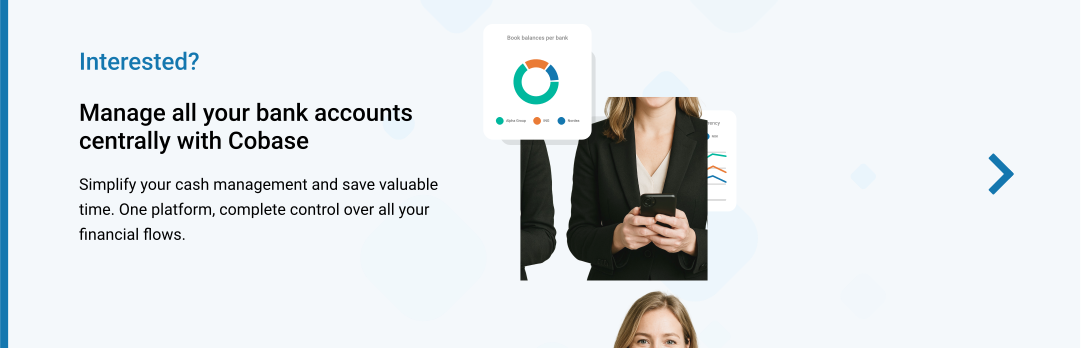
Cobase helps companies connect more than 300 banks worldwide to one secure and centralized platform, giving you full visibility and control over your cash. Instead of managing separate portals and manual processes, you can initiate payments, access balances, automate reporting, and apply consistent approval workflows across all your banks in one place. With broad global connectivity, strong security standards, and structured implementation support, Cobase enables treasury and finance teams to work more efficiently while reducing operational risk. If you are ready to simplify your banking landscape and strengthen control, Cobase provides the technology and expertise to make it happen.
Frequent Asked Questions (FAQs)
1. Do I need to consolidate my banks to use a single platform?
No. Most platforms are designed to connect to multiple existing banks without requiring consolidation.
2. What is the biggest benefit of connecting multiple banks?
Improved cash visibility. Seeing your full liquidity position in one place enhances decision-making immediately.
3. How long does implementation typically take?
It depends on the number of banks and use cases, but phased rollouts allow value delivery within months rather than years.
4. Is it secure to centralize bank connectivity?
Yes, if implemented correctly with strong authentication, encryption, and role-based controls.
5. Can small or mid-sized companies benefit from multi-bank platforms?
Absolutely. Complexity grows quickly with expansion, and early centralization prevents future operational strain.


